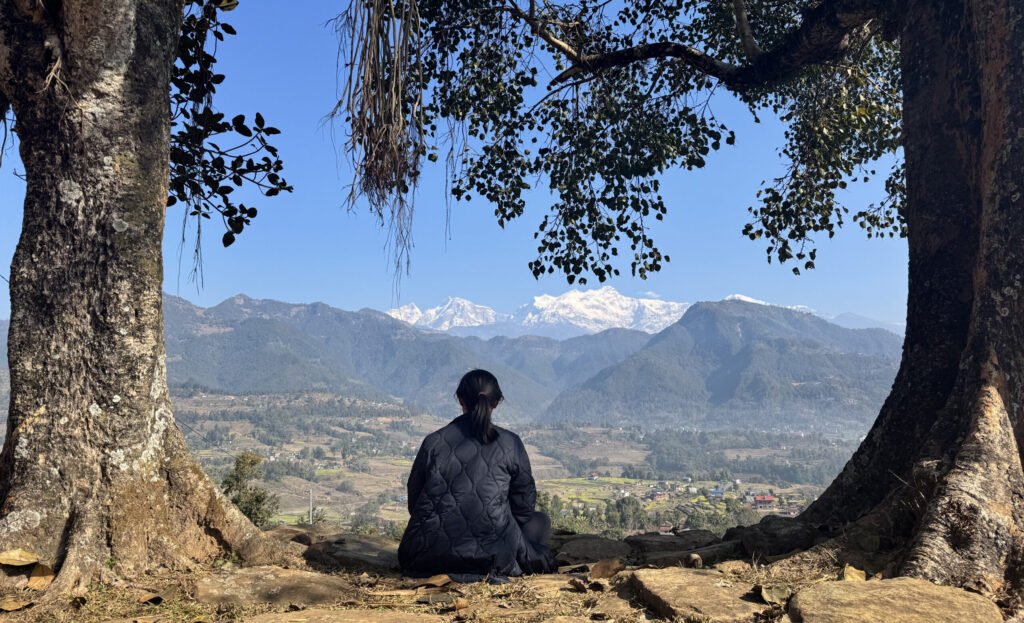
Despite the rocky roads and the risk of landslides, I slept soundly on the bus in Nepal.
My home in Lamjung District was a seven-hour bus ride from Kathmandu. I would arrive at the chaotic Gongabu Bus Park in the early morning, call out the name of my village, and within seconds someone would point me toward the right vehicle. I couldn’t read the writing on the bus to confirm the destination, and I never knew when we would actually depart, but I was always confident I would be home before sunset.
Early in my Peace Corps service, I was trying to describe my final stop to a bus driver, using my broken Nepali with an admittedly American accent. The bus driver seemed confused, but the man sitting beside me interrupted and explained it clearly on my behalf. He said not to worry because he knew where I lived. He was friends with my host father. He then proceeded to show me the box of chickens in his lap with great pride. He shared something that was meaningful to him, and that was significant to me. I felt reassured and I was even able to sleep on the long journey.
In hindsight, it may be naive to fall asleep on a crowded bus full of strangers in an unfamiliar country. But at the time, and in that context, it didn’t feel strange at all. It felt like people knew me, were looking out for me, and I could finally unwind.
Nine months later, I returned to the United States and noticed an immediate shift. I no longer trusted people in the same way.
Upon arrival at my home airport, the first thing I found myself doing was seeking out a baggage claim attendant. She didn’t seem invested in my problem and didn’t seem to care that my lost bag mattered to me. She filled out a lost baggage ticket, asking me identifying questions about my bag. When I asked for a printed copy, I saw that basic details were incorrect, even something as simple as the color of my bag. It struck me that I could communicate with her in my native language, and yet had such little faith that the process would actually deliver.
Since then, I have continued to notice the shift in smaller ways. I lock my car doors at traffic lights and I hesitate before asking anyone for help. I am more alert, more guarded, more aware of potential risk. If someone showed me a box of chickens on a bus in San Francisco, I would be exceptionally on edge, not at ease.
The trust I had felt in Nepal disappeared almost immediately upon returning home. This contrast compelled me to confront a question I hadn’t fully considered before: where does trust actually come from?
In Nepal, trust seemed to exist without formal structure. Buses left when they were full, not necessarily when they were scheduled. Package deliveries were simply handed to someone traveling that way, without tracking or confirmation. Directions were given through relationships rather than addresses. There were fewer formal mechanisms of accountability, and yet, things worked. It was not always perfect, but it was reliable enough. I reached where I had intended and felt safe getting there.
In the United States, I experience the opposite, where systems are heavily regulated. There are rules for everything from transportation, to transactions, and interactions. In theory, these systems are designed to create safety and predictability, but they do not necessarily create trust. The more structured and regulated the environment, the more I find myself relying on the system rather than the people within it. Trust and responsibility shift away from individuals and toward institutions.
My experience in Nepal was not blind trust. My experience was social accountability.
In a more interconnected community, like my small town in Nepal, people are not anonymous. Your actions carry weight because they are visible, reputation matters, and relationships are strong. If someone misleads you on a bus, it is not an isolated interaction, rather it is part of a broader social fabric where behavior has consequences.
The man with the chickens didn’t help me simply because he was kind. He helped me because helping was expected. He helped me because, in an intimate community, people are accountable to one another in ways that extend beyond a single moment. He helped me because he knew my host father and my host father knew him. Trust in that context is not a leap of faith, it is a reflection of shared expectations.
In the United States, that form of accountability is more difficult to maintain. Interactions are often brief, transactional, and anonymous. The person sitting next to you on a bus is unlikely to know your family, your home, or your story. There is no social fabric binding you together, only a shared space for a limited time.
In the absence of social accountability, we build systems to provide continuity. We have forms, procedures, and tickets like the one I stood filling out at the airport. We create rules, regulations, and oversight mechanisms designed to ensure fairness and safety. These systems are necessary, especially in large, complex societies, but they also change the nature of trust. Instead of trusting people, we trust processes. Instead of relying on relationships, we rely on enforcement.
I began to contemplate how trust, as I experienced it in Nepal, is fundamentally tied to scale. Human beings are not wired to meaningfully know or feel accountable to millions of people. We are built for smaller communities where relationships are visible and reputations matter. When societies grow, anonymity expands. With anonymity comes a weakening of informal accountability, and regulation arises to compensate.
The problem is that regulation has limitations. It can enforce behavior, but it cannot create the underlying social bonds that make trust feel natural. It can prevent harm, but it cannot generate the confidence that allows you to fall asleep on a bus full of strangers.
I don’t think Nepal is a utopia, nor do I think the United States is uniquely flawed. Both systems reflect the realities of their scale and history. However, this experience challenged my assumption that more rules create more trust. True trust does not come from regulation; it comes from social accountability, and social accountability only works at human scale.
I consider that bus ride and try to imagine it unfolding here. I know I would stay awake, I would hold my bag a little closer, and I would question the kindness instead of accepting it. And once you’ve experienced a place where trust feels natural, not negotiated, it becomes harder to accept a world where it doesn’t.
I don’t know how to rebuild that kind of trust at scale, or if it’s even possible. However, I now know what it feels like to live within it, and that memory has reshaped how I move through the world.